
1. July 2026 Volatility: We Noticed It Before the SEO Community
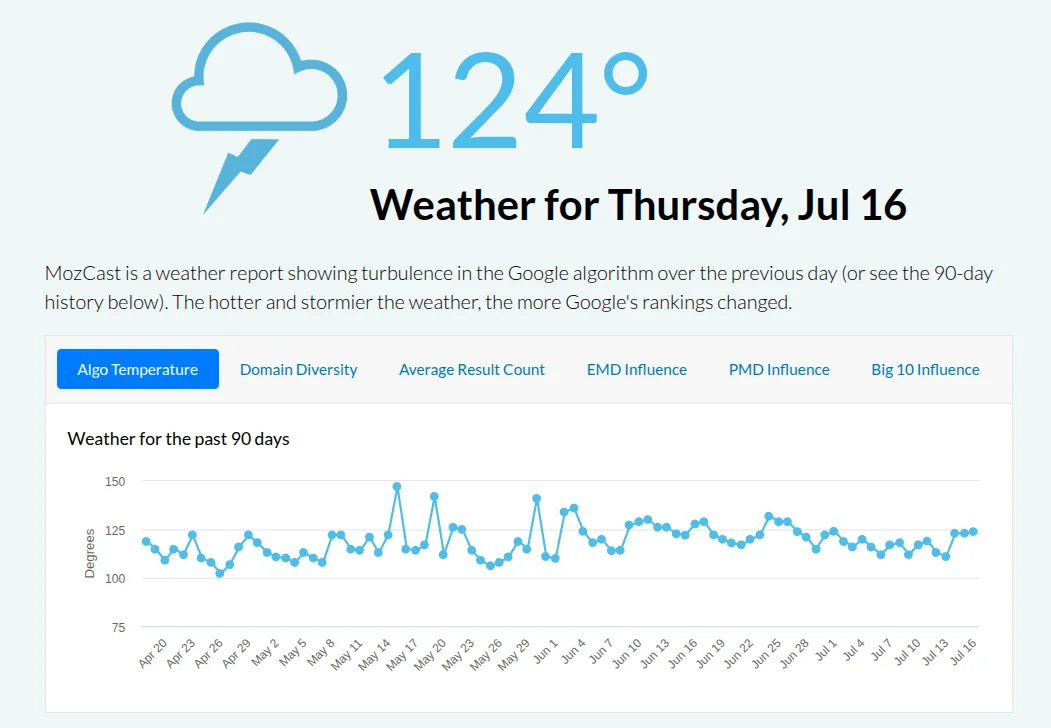
On July 13, Barry Schwartz published an article summarizing an unconfirmed wave of Google ranking volatility that the SEO community quickly nicknamed the "7-Eleven Update". The publication was based on observations from Glenn Gabe, third-party volatility trackers, and discussions among SEO specialists. Interestingly, despite clear signals from monitoring tools, the community itself remained relatively quiet compared to previous algorithm shifts.
What caught my attention was something different.
Across several niche websites that I actively develop and optimize, I observed significant changes already on July 9, several days before the broader discussion appeared in the SEO community. All of these projects follow the same philosophy: high-quality, expert content and systematic implementation of Google's E-E-A-T principles.
The most interesting observation was that the changes did not follow the classic SEO pattern. Instead of a simple increase or decrease in rankings, I saw a characteristic combination:
-
organic traffic increased,
-
while the total number of ranking keywords decreased.
At first glance, these metrics seem contradictory. In reality, however, they may indicate that Google became more selective, reducing visibility for less valuable queries while simultaneously rewarding pages for searches with higher intent and greater business value. This is exactly the kind of behavior that would fit an algorithm placing more emphasis on content quality, expertise, and user satisfaction than on the sheer number of indexed keywords.
Although Google has not officially confirmed any ranking update during this period, the timing of these changes aligns closely with the volatility reported by multiple independent tracking tools and later described by Barry Schwartz and Glenn Gabe.
2. Why Is This Important to Me?
These observations come from a group of niche business websites that were not managed particularly well between 2022 and 2024. They were never hit by the Helpful Content Update (HCU) or any Core Update, but they were gradually losing visibility and organic traffic over time.
At the beginning of 2025, I took over these projects and started rebuilding them around Google's E-E-A-T principles as closely as possible. Since then, I have also focused heavily on increasing Information Gain through original, experience-based content. Since the June 2025 Core Update, every subsequent broad update has resulted in growth across these sites—sometimes modest, sometimes significant, but consistently positive.
These are relatively small niche business websites, so their overall traffic and keyword footprint are naturally much lower than those of large publishers. Ironically, this makes them excellent "test subjects," because changes in Google's behavior become much easier to spot.
One pattern has repeated itself almost every time.
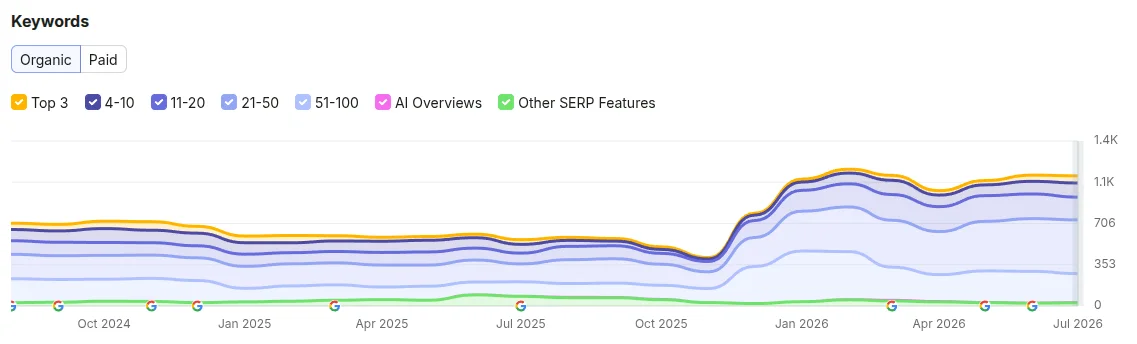
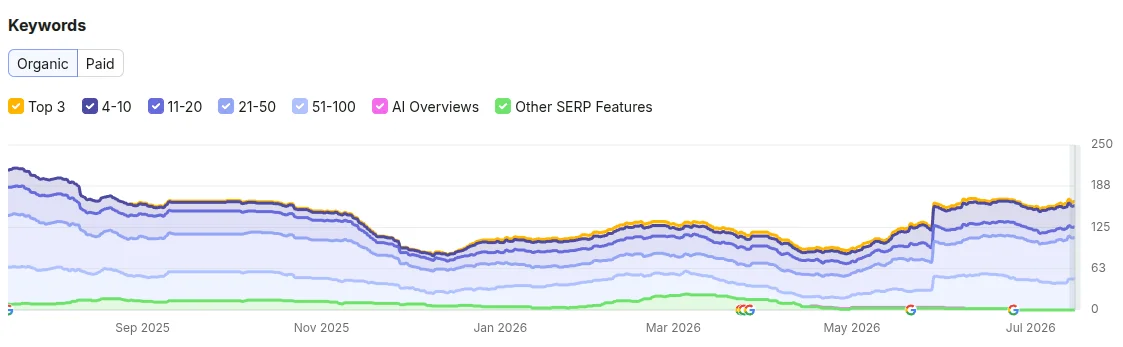
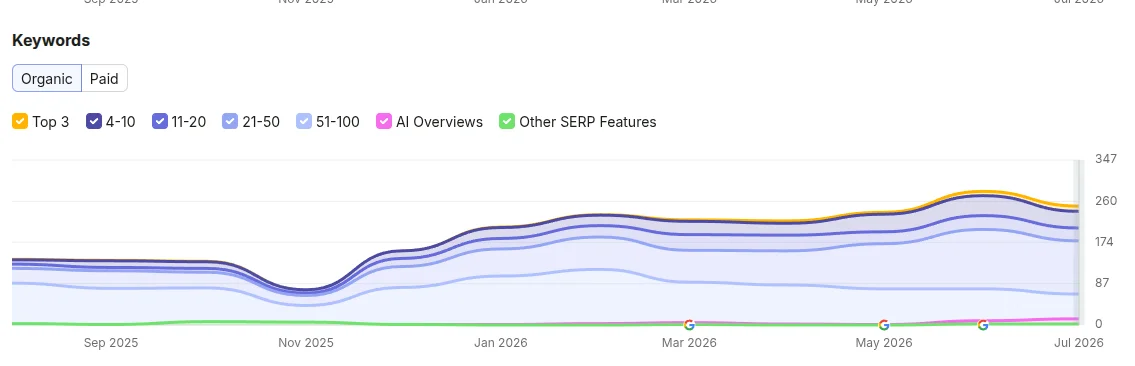
Several weeks before a Core Update is officially announced, these sites begin losing ranking keywords, while subtle ranking fluctuations start appearing in Google Search. This period typically lasts four to five weeks, after which Google announces a new Core Update.
The only notable exception was the December Core Update, which arrived much later than expected. As we know, there was an unusually long 164-day gap between official Core Update announcements, temporarily breaking the pattern I had been observing.
Read: May 2026 Core Update Has Officially Started
3. A Subtle Chain of Events
A drop in ranking keywords alone does not necessarily indicate that a Core Update is approaching. It may simply reflect one of Google's countless smaller adjustments. However, the pattern I'm describing is different—it persists continuously, with varying intensity, right up until the Core Update is officially released.
What I repeatedly observe is the convergence of three signals:
- Increased volatility in Google Search results.
- A gradual decline in the total number of ranking keywords.
- A time window in which a new Core Update would historically be expected.
There is also a fourth element that makes this period particularly interesting.
On August 12, 2026, Google will hold its Made by Google 2026 event. If you remember December 2025 and Google I/O 2026 (May 19–20), major Google announcements have previously coincided with significant changes in Search. Of course, this is not evidence that another Core Update is imminent—it is simply another subtle correlation that, over time, may turn out to be part of a recurring pattern rather than a coincidence.
4. When Could the Next Core Update Arrive?
If my observations are correct, everything points to the next Google Core Update arriving in August 2026.
Isn't that too soon? I don't think so. In fact, a recent court ruling in Germany may help explain why Google could be accelerating the pace of major Search updates.
On May 28, 2026, the Munich Regional Court (Case No. 26 O 869/26) issued a landmark decision, ruling that Google may bear direct civil liability for false or defamatory content generated by AI Overviews.
The court rejected Google's argument that it merely operates as a search engine protected under the EU's Digital Services Act (DSA). Instead, it concluded that AI-generated summaries are independent pieces of content created by Google itself, rather than simple presentations of third-party search results.
The judges also ruled that disclaimers such as "AI may make mistakes" and links to source material do not exempt Google from liability. In the case at hand, the AI-generated summary allegedly distorted facts and falsely accused publishers of fraud and "subscription traps."
The implications extend beyond this single lawsuit. On July 14, 2026, Germany's media regulator (ZAK) announced that it would begin applying media law to AI-generated summaries produced by Google and Perplexity.
From Google's perspective, increased legal responsibility creates a strong incentive to improve the quality and reliability of AI-generated Search results as quickly as possible. If AI-generated answers can expose the company to legal claims, releasing major Search improvements more frequently may become more practical than collecting data for months and shipping only two or three Core Updates per year.
Whether this legal pressure is already influencing Google's update cadence remains speculative—but it is certainly another piece of the puzzle worth considering.
Summary
No one outside Google knows exactly when the next Core Update will be released. Everything in this article is based on observations, historical patterns, and publicly available information—not insider knowledge.
What makes this period interesting is the combination of several independent signals occurring at the same time:
- increasing ranking volatility across Google Search,
- a noticeable decline in the number of ranking keywords on several E-E-A-T-focused websites,
- the historical timing in which another Core Update would be expected,
- and growing legal pressure surrounding AI-generated Search results.
Individually, none of these factors proves that a Core Update is imminent. Together, however, they paint a picture that looks remarkably familiar.
If history repeats itself, August 2026 could become another important milestone for Google Search. If not, these observations will simply become another valuable data point in understanding how Google's ranking systems continue to evolve.
As always, the best long-term strategy remains unchanged: build genuinely useful content, demonstrate real experience and expertise, and focus on creating value for users rather than chasing every ranking fluctuation. Time has shown that this approach survives algorithm updates far better than short-term SEO tactics.