
A few days ago, I wrote about major turbulence in Google’s search results around May 8. At the time, it seemed to me that Google was rolling out corrections after the March core update. However, it now appears that those changes were simply preparations and testing before launching another broad core update.
In my opinion, the March core update heavily overemphasized domain authority. In many industries, expert websites started losing visibility to large brands and government websites that often provided no real information gain and did not better satisfy user intent. Search results became dominated by “safe” domains, but not necessarily the most valuable ones.
Honestly, after waiting more than five months for the December 2025 core update, I did not expect Google to release another broad core update so quickly after the March rollout.
A table showing the intervals in days between Google Core Updates:
| Core Update | Date | Days Since Previous Core Update |
|---|---|---|
| May 2026 core update | 21 May 2026 | 55 days |
| March 2026 core update | 27 Mar 2026 | 87 days |
| December 2025 core update | 11 Dec 2025 | 164 days |
| June 2025 core update | 30 Jun 2025 | 109 days |
| March 2025 core update | 13 Mar 2025 | 91 days |
| December 2024 core update | 12 Dec 2024 | 31 days |
| November 2024 core update | 11 Nov 2024 | 88 days |
| August 2024 core update | 15 Aug 2024 | 163 days |
| March 2024 core update | 5 Mar 2024 | 124 days |
| November 2023 core update | 2 Nov 2023 | 28 days |
| October 2023 core update | 5 Oct 2023 | 44 days |
| August 2023 core update | 22 Aug 2023 | 160 days |
| March 2023 core update | 15 Mar 2023 | 181 days |
| September 2022 core update | 12 Sep 2022 | 110 days |
| May 2022 core update | 25 May 2022 | 327 days |
| July 2021 core update | 1 Jul 2021 | 29 days |
| June 2021 core update | 2 Jun 2021 | — |
Why Is This Update More Important Than the Previous Ones?
This is where the analysis begins.
The May 2026 Core Update is most likely part of a bigger transformation from Search to AI Search. Timing is crucial here. As I mentioned earlier, many SEO experts — including myself — were wondering at the end of the first third of May whether Google was correcting the search results after the March core update.
Why?
Because the results were simply terrible. Google pushed too far toward safety and domain authority. Informational pages started ranking for transactional queries, which created a major mismatch with user intent. Instead of fighting spam in March, Google decided to tighten the authority signals even more.
However, it turned out that authority often has nothing to do with truly relevant and in-depth content.
Why? It’s simple.
In large companies, content is usually written by copywriters who mainly build their articles based on research. Imagine an employee spending several days gathering information, doing research, and publishing an article on their boss’s blog. Very often, those same people start their own businesses and begin publishing content on their own websites.
And those are exactly the kinds of publishers Google partially wiped out during the March core update because they did not have the backing of massive domain authority.
That is why I believe the May 2026 Core Update is happening now — to partially fix this situation.
What Do the First Signals From the SEO Industry Show?
The first signals coming from the SEO industry are very interesting, but at the same time highly mixed. Volatility tools, discussions on WebmasterWorld, SERoundtable, and observations from many SEO specialists show that major ranking shifts started appearing even before the official rollout of the May 2026 Core Update.
During the May testing phase, it was already noticeable that smaller company websites were starting to enter the TOP10 results. I always analyze such cases very carefully. Often, those websites disappear from the rankings again after a few days, but I am always interested in one thing — what exactly made Google pay attention to them.
And in almost every case, some kind of authority is visible. Not big-brand authority, but authority built through experience, knowledge, and depth of content. Very often, these websites perfectly match user intent or build an entire ecosystem of content around their niche, almost like a true knowledge base.
The testing phase itself already suggested that Google was beginning to move away from the March “brand obsession” and was looking for a better balance between domain authority and actual content value.
At the same time, strong reshuffling in the TOP10 is still clearly visible. Some websites are gaining visibility rapidly, while others are losing rankings almost overnight. In many industries, the importance of brand signals is still increasing, but at the same time more expert-driven and highly specialized sources are also starting to gain visibility.
This was also clearly visible in WebmasterWorld discussions:
“Our vertical is replaced with untrustworthy and limited professional competence ecom-shops. All the professionals are gone.”
“This CU was very bad for users because they will now get low quality or false items.”
“Google consistently reducing traffic to valuable web resources and promoting useless trash instead.”
“The worse the site and the page, the higher it ranks.”
“Google seems to reward trusted entities over generic informational pages.”
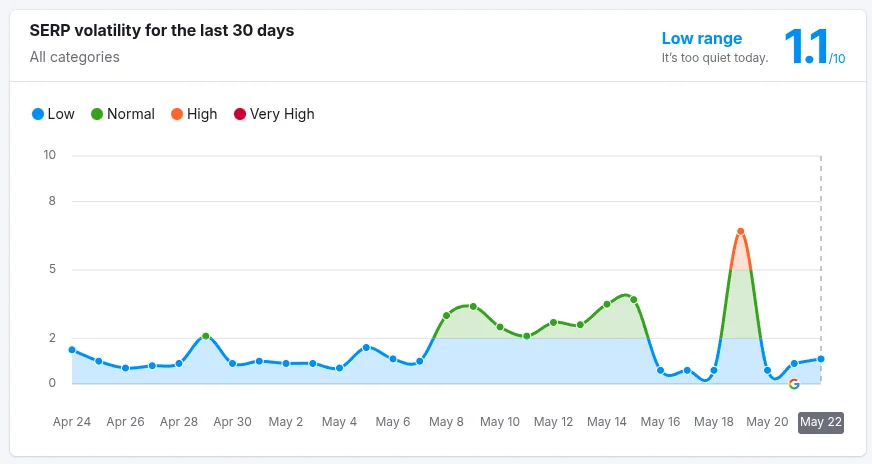
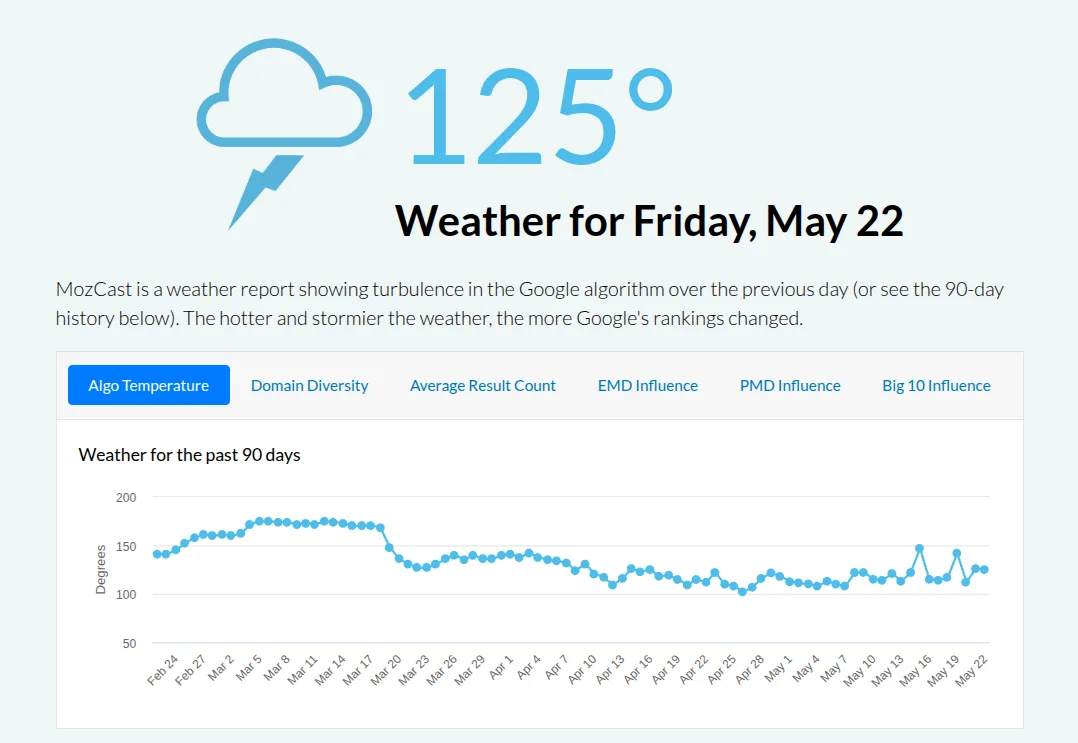
Interestingly, MozCast shows clearer signs of possible testing activity before the May 2026 Core Update. The chart shows increased algorithm temperature starting around May 8, along with two stronger spikes around May 15 and May 19. The spike on May 19 is especially interesting because it appeared just two days before the official announcement of the new core update.
Semrush Sensor presents the situation a bit differently. Apart from the very strong spike on May 19, the chart remains relatively calm. However, I feel that the Semrush metric is currently too “understated” compared to the actual movements happening in the SERPs. In practice, it often still shows green or low volatility levels at moments when many SEO specialists are already observing very significant ranking fluctuations. Considering the scale of changes visible across many industries, some of those readings should probably be orange or even red instead.
Of course, it is still far too early for final conclusions. The rollout has only just started, and a lot can still change. For now, I am observing the situation very carefully.
What Could Google Reward in 2026?
Looking at the direction of changes in Google Search, several very clear trends can already be seen. In theory, Google wants to increasingly reward:
- brand authority,
- E-E-A-T,
- real experience,
- original research,
- high-quality answers,
- and content prepared for AI Search.
More and more people are also saying that Experience is starting to outperform typical AI rewritten content. Google is getting better at detecting rewritten articles, AI paraphrasing, and classic “SEO pages without value” — pages created mainly for rankings rather than for real users.
On top of that, there are behavioral signals connected to user satisfaction:
- pogo sticking,
- interaction quality,
- engagement depth,
- and overall satisfaction after visiting a page.
At the same time, content optimized for AI Search is becoming increasingly important:
- AI Overviews,
- entity SEO,
- answer extraction,
- semantic clarity,
- and how easily AI models can interpret the content.
All of this sounds great — and these are, of course, the official directions and recommendations promoted by SEO experts. The problem is that reality looks a little different.
Let’s be honest: the guidelines above are more of Google’s vision and dream of what the internet should look like and what kind of content it would like to promote. Execution, however, is much more difficult.
In the era of cheap AI-generated content created massively for bots and algorithms, Google needs enormous computing power just to navigate such an environment efficiently. On top of that, there is massive spam and an overwhelming amount of low-quality content that constantly needs to be filtered out.
And that is exactly why, in practice, rankings are often not determined purely by content quality alone.
Domain authority and brand strength still have enormous influence.
One large website publishes mediocre fluff content, while a smaller blogger creates truly excellent and in-depth material. The problem is that the algorithm has to mathematically decide which source deserves more trust.
And that is not simple at all.
Because that same blogger could also be a very clever spammer who knows exactly how to manipulate search engines and ranking signals.
Who Could Lose After the May 2026 Core Update?
I think that, as usual, the biggest losers will be spammers, copywriters reheating old internet content, and websites created purely for algorithms.
The most vulnerable groups include:
- affiliate sites without real expertise,
- mass AI content,
- thin comparison pages,
- parasite SEO,
- generic TOFU blogs,
- content farms,
- and aggregators offering no unique value.
For a long time, Google has been trying to fight content that is technically “SEO-correct” but in reality adds nothing new to the internet. The problem, however, is that after the March 2026 Core Update, Google probably overcorrected in the opposite direction.
And this is where things become very interesting.
I think large brands may also lose this time.
Yes — large and extremely powerful domains.
The March core update significantly boosted the visibility of many large websites, even when they were publishing average or highly generic content. In many cases, domain authority alone was enough to outrank smaller but far more expert-driven websites.
The problem is that users are not ultimately searching for “a big brand.” Users are searching for the best answer.
And I think Google has started to notice that.
That is why I believe the May 2026 Core Update may be an attempt to better rebalance the space between smaller websites with genuinely great content and giant brands publishing weak or diluted content.
Of course, this does not mean the end of brand authority. Quite the opposite — authority will still matter enormously. However, I think Google may start analyzing much more carefully whether real quality, experience, and genuine information gain actually stand behind that authority.
Who Could Benefit?
If my interpretation of the May 2026 Core Update is correct, the biggest winners may turn out to be smaller publishers creating genuinely valuable content. At least that is what the logic of the changes suggests based on what we started observing during the May testing phase.
The biggest growth opportunities may belong to:
- niche experts,
- branded publishers,
- websites building strong topical authority,
- first-hand experience content,
- data-driven content,
- community-driven sites,
- and real businesses with practical knowledge and experience.
Google will probably still rely heavily on domain authority, but it seems the algorithm is beginning to search again for a balance between “brand strength” and actual content quality.
And this is exactly where smaller publishers may finally get their chance.
Especially those who have spent years building true ecosystems of knowledge around their websites, solving specific user problems, and creating content based on real experience rather than purely on research or AI paraphrasing.
I also feel that the overall consistency of an entire website is becoming increasingly important. Not just a single article, but the full context of the website — its topical authority, history, specialization, and the signals showing that real people or a real business stand behind the project.
If this direction continues, the May 2026 Core Update could become the first signal in a long time that Google is trying to reopen space for smaller but genuinely valuable web creators.
Summary
The May 2026 Core Update may turn out to be one of the most important Google updates of 2026. Not because it completely reinvents SEO, but because it likely reveals the direction in which Google Search is evolving in the era of AI Search.
The March core update heavily shifted the balance toward domain authority and “safe” brands. The problem, however, was that authority does not always mean the best answer for users. In many industries, large domains publishing average content started winning, while smaller experts and specialized publishers lost visibility despite producing high-quality material.
The first signals surrounding the May 2026 Core Update suggest that Google may have recognized this problem and is now trying to partially correct the direction it took in March. Authority, brand signals, E-E-A-T, and domain trust will still remain extremely important.
At the same time, it appears that the algorithm is once again starting to analyze more carefully:
- user intent alignment,
- content depth,
- topical authority,
- real experience,
- and actual information gain.
Will Google solve the search quality problem? Honestly — I do not know. The scale of AI spam and mass-produced content today is enormous, and finding the balance between domain authority and real content value is one of the hardest challenges modern search engines face.
One thing, however, seems certain: SEO in 2026 is becoming less and less about “optimizing for algorithms” and more and more about building genuine value, expertise, and trust around an entire web project.
And perhaps that is exactly why this core update is so interesting.